Nursing education · Gamified clinical learning
TRIAGED
Team-based Risk Identification and Assessment with Gamified Exploration, Determined by students
TRIAGED turns students from readers of a case study into its authors. The dice provide one prompt at a time, but they do not provide the patient. Students decide what each result means, drawing on previous learning, experiences from practice and the knowledge within their group.
As each new factor appears, the clinical picture changes. Students identify what matters at that point, revisit their earlier thinking and build a cumulative assessment rather than waiting until the end to decide what the risks are.
When the case is complete, it is referred to another team. That team receives the patient their peers have created and must use the documentation provided to identify priorities and develop evidence-informed interventions.
Student Nursing Times Awards 2025
The dice provide the prompt. Students create the person.
TRIAGED is not a randomly generated case study. Each roll gives the group a constraint. The students supply the clinical detail and decide how that new information fits with everything they already know about their patient.
-
01
Roll
Reveal one new piece of information.
-
02
Build
Use learning and experience to decide what the prompt means for this person.
-
03
Assess
Identify and document the risks visible at this point in the case.
-
04
Reassess
Roll again and revisit earlier judgements as the picture develops.
-
05
Refer
Pass the completed patient and documentation to another team.
-
06
Respond
The receiving team interprets the referral and develops evidence-informed interventions.
-
07
Debrief
Bring the groups together to compare reasoning and explore what changed along the way.
The uncertainty is deliberate. In practice, nurses rarely receive a complete picture all at once. TRIAGED asks students to reason with what they know now, while remaining ready to change that judgement when they know more.
The TRIAGED Collection
The underlying approach stays the same, while the prompts and learning focus change.
-
Playable
Original
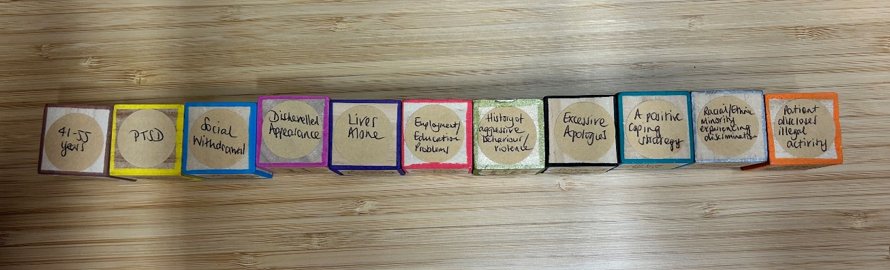
The original eleven-dice mental health nursing activity. Students build a patient progressively, reassess risk after every roll and refer the completed case to another team.
-
Playable
Trauma
A trauma-informed twelve-dice adaptation exploring adverse childhood experiences and adult trauma through a developing patient story.
-
Playable
PDT training
A nine-dice adaptation for Personal Development Tutor training, where staff collectively develop and respond to complex student scenarios.
-
In development
Child health
An adaptation of the TRIAGED approach for child health nursing, currently being developed with colleagues.
 Where it started
From eleven wooden dice to TRIAGED
TRIAGED started life as eleven wooden dice with handwritten labels. The idea was simple: make teaching risk assessment more active while bringing some of the unpredictability of mental health nursing practice into the classroom.
What developed was more than a set of prompts. Students used each roll to create their own patient, drawing on what they had learned in university and what they had encountered in practice. Their assessment changed as the person changed, and the completed case was then handed to another group to work with.
Students enjoyed it, I enjoyed teaching with it, and interest from other educators kept growing. The dice are now online so that other educators can use and adapt the approach with their own learners.
Avril Montgomery
Lecturer in Mental Health Nursing,
Edinburgh Napier University
Using TRIAGED in teaching
Each published version is free to use in nurse education. The teaching guidance explains how to structure the activity and facilitate the discussion, while the citation page gives the appropriate attribution for each version.
I would love to hear about it: where you are using it, what you have changed, and how your learners responded. It takes about two minutes.